Introduction: Trust Is Built, Not Assumed
The single most common concern about remote and outsourced teams is trust: How do you know people are actually working? How do you maintain accountability when you cannot see the work happening? These are the wrong questions. High-performing teams — remote or in-office — are built on trust, and trust is built through intentional systems, transparent communication, and consistent delivery. This guide provides the proven framework.
1. Start With Crystal-Clear Expectations
Trust begins with clarity. Before a remote or outsourced team starts work, invest time defining exactly what success looks like: deliverables, quality standards, communication protocols, response time expectations, and performance metrics. Ambiguity is the enemy of trust. Clarity is its foundation.
- Document everything: Create written briefs, process documentation, and success criteria that everyone can reference
- . Define KPIs upfront: Establish measurable outcomes so performance is objective, not subjective.
- Set communication norms: Specify expected response times, meeting cadence, and escalation procedures.
2. Use Asynchronous Communication as Your Default
Asynchronous-first communication — where team members document decisions, progress, and blockers in writing rather than relying on synchronous meetings — creates a transparent record of work that builds trust organically. Tools like Notion, Slack, Loom, and project management platforms enable teams to stay aligned without constant oversight.
3. Measure Outcomes, Not Hours
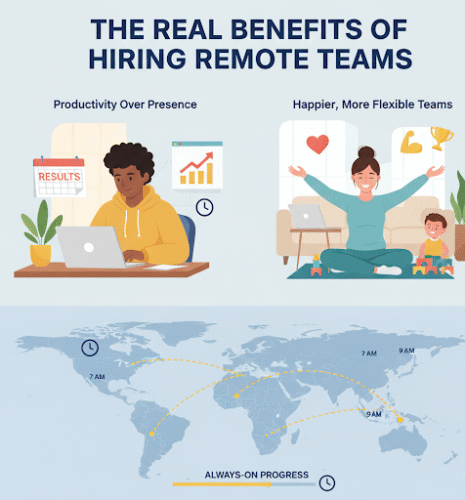
The fastest way to destroy trust with remote teams is to implement surveillance software that tracks keystrokes and screen time. High-performing remote teams are managed through outcomes: Did the work get done? Was it high quality? Was it on time? Hours worked is a poor proxy for value delivered. Focus on results.
4. Invest in Relationship-Building
Trust is not purely transactional — it is relational. Schedule regular video calls, celebrate wins publicly, share context about broader company goals, and treat remote team members as genuine partners rather than invisible service providers. Small investments in relationship-building yield disproportionate returns in trust and performance.
5. Start Small and Prove Value
If you are new to remote or outsourced teams, start with a contained pilot project before committing to full-scale delegation. A successful small engagement builds confidence and demonstrates capability, making subsequent scaling decisions easier. Trust grows through demonstrated performance, not blind faith.
Conclusion: Trust Through Systems, Not Surveillance
The companies that build the highest-trust remote and outsourced teams are not those with the most surveillance tools — they are those with the clearest systems, the most transparent communication, and the deepest investment in treating distributed workers as valued team members. Trust is not granted at the start; it is earned through consistent delivery and built through intentional frameworks. Get those frameworks right, and trust becomes the natural outcome.