

Every business owner faces the same fundamental constraint: there are only so many hours in a day, and only so many things your core team can do well. The companies that scale successfully are not those that try to do everything in-house — they are those that strategically delegate non-core operations to specialized partners, freeing internal resources to focus on competitive differentiation, innovation, and growth.
Outsourcing operations is not about cutting corners. It is about making a deliberate strategic choice to access specialized expertise, reduce fixed costs, and build a more flexible, resilient business model. This guide explains why outsourcing operations is one of the smartest moves a growing business can make.
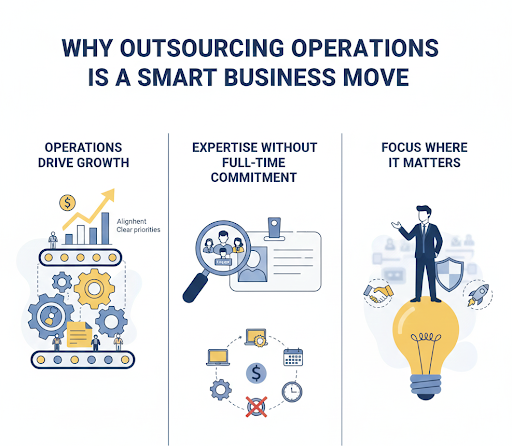
Building in-house operational capabilities — whether IT infrastructure, accounting systems, customer support workflows, or HR compliance — takes years of hiring, training, and process refinement. Outsourcing delivers those capabilities immediately. Reputable outsourcing partners have already invested in training, technology, and process optimization. You get day-one access to mature, proven systems without the multi-year buildup.
In-house operations create fixed cost structures: salaries, benefits, office space, equipment, and management overhead remain constant whether business is booming or slow. Outsourcing converts these fixed costs into variable operating expenses that scale up and down with demand. This financial flexibility is particularly valuable for seasonal businesses, project-driven companies, and any organization navigating economic uncertainty.
One of the most undervalued benefits of outsourcing operations is the leadership time it recovers. Managing operational complexity — IT troubleshooting, payroll processing, customer support escalations, compliance updates — consumes hours every week that could be spent on product development, market expansion, strategic partnerships, and revenue growth. Outsourcing these functions returns that bandwidth to your leadership team.
Outsourcing distributes operational risk across multiple providers and geographies. If a single in-house team member leaves, you lose institutional knowledge and capacity. If an outsourcing partner experiences turnover, they absorb the replacement cost and continuity risk — not you. This built-in redundancy significantly improves business resilience.
Outsourcio.com connects businesses with pre-vetted, fully managed remote teams across every major operational function — from finance and IT to customer support and marketing. With transparent pricing, flexible contracts, and proven delivery frameworks, Outsourcio eliminates the complexity and risk traditionally associated with outsourcing. Whether you need a single specialist or an entire department, Outsourcio makes it simple to delegate strategically and scale intelligently.
The most successful businesses are not those that do everything themselves — they are those that focus relentlessly on their core competitive advantage and outsource the rest to specialists. Outsourcing operations is not a cost-cutting tactic. It is a strategic decision to build a more flexible, expert-driven, and resilient business model. The companies that embrace this reality are the ones that will lead their industries.



Outsourcio helps businesses scale efficiently by connecting them with on-demand remote professionals and operational support. We make it easy to hire fast, reduce costs, and build high-performing teams, so you can focus on what matters most.