

For startups, every dollar, every hire, and every hour of founder time is precious. The companies that succeed are not those with the biggest budgets — they are those that deploy resources with surgical precision. Remote hiring and outsourcing are among the most powerful strategic tools available to early-stage companies because they enable speed, flexibility, and capital efficiency that traditional hiring cannot match.
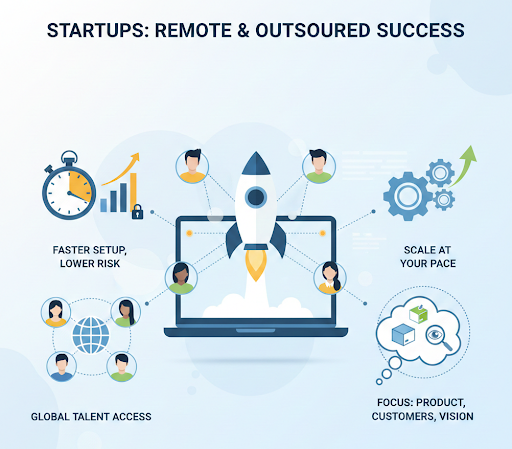
Startups competing for talent in major tech hubs face an impossible salary war with well-funded incumbents. A senior engineer in San Francisco commands $180K+ in total compensation. Remote hiring unlocks global talent pools where equivalent expertise costs $50K–70K — allowing startups to hire 2–3 exceptional people for the cost of one local hire.
Runway is the lifeblood of startups. Remote hiring and outsourcing dramatically extend runway by converting expensive full-time hires into flexible, variable costs. A startup that replaces three $120K in-house hires with remote equivalents at $50K each saves $210K annually — enough to fund an additional 6–12 months of operation.
Speed is the ultimate competitive advantage for startups. Remote hiring compresses time-to-hire from 3–6 months (traditional) to 2–4 weeks (remote platforms). Outsourcing delivers specialized capabilities — design, development, marketing, operations — instantly, without months of recruiting. This speed advantage translates directly into faster product launches, quicker market feedback cycles, and more iterations before competitors catch up.
Startup founders have limited bandwidth. Managing operational complexity — HR, payroll, office logistics, compliance — consumes hours that should be spent on product development, customer acquisition, and fundraising. Outsourcing operational functions returns that time to founders, enabling them to focus entirely on the activities that determine startup success or failure.
One of the hardest challenges in startup scaling is maintaining culture as headcount grows. Remote-first cultures are often more intentional, documented, and values-driven than office cultures because they must be explicit rather than osmotic. Startups that build strong remote cultures from day one often find they scale more smoothly than those that try to retrofit remote work onto an office-dependent culture.
The startups that will define the next decade are not those with the biggest Series A rounds or the fanciest offices — they are those that deploy capital with ruthless efficiency, move faster than competitors, and access the world’s best talent regardless of location. Remote hiring and outsourcing are not cost-cutting tactics for startups. They are strategic superpowers that enable lean, fast, globally competitive companies to win.


Outsourcio helps businesses scale efficiently by connecting them with on-demand remote professionals and operational support. We make it easy to hire fast, reduce costs, and build high-performing teams, so you can focus on what matters most.